
Photographing Your Featherfins: Capturing Their Ephemeral Beauty

Welcome to Aquarium Mastery, where we unlock the secrets to thriving aquatic ecosystems!
Ever tried capturing the fleeting grace of your Featherfin? These magnificent creatures deserve to be immortalized, but photographing them can be a challenge. Dive into our latest article, "Photographing Your Featherfins: Capturing Their Ephemeral Beauty," and discover practical Featherfin aquarium photography tips that will transform your snapshots into stunning portraits. Ready to showcase the unique charm of your freshwater companions? Let's begin!
- Introduction to Featherfin Cichlid Photography
- Essential Equipment for Featherfin Aquarium Photography
- Featherfin Aquarium Setup for Optimal Photography
- Featherfin Photography Techniques: Tips and Tricks
- Post-Processing Featherfin Aquarium Photos
- Advanced Featherfin Photography Techniques
- Troubleshooting Common Featherfin Photography Issues
- Showcasing Your Featherfin Photography
- Conclusion: Mastering Featherfin Aquarium Photography
-
Frequently Asked Questions
- How can I best capture the delicate details of my Featherfin Catfish in a photograph?
- What camera settings are ideal for photographing Featherfin Catfish in an aquarium?
- How do I deal with the reflections and glare from the aquarium glass when photographing my Featherfins?
- What are some techniques for getting my Featherfin Catfish to pose for a photo?
- How can I improve the overall composition of my Featherfin aquarium photographs?
- Final Reflection: Embracing the Fleeting Moment
- Unveil the Masterpiece: Immortalize Your Featherfins!
Introduction to Featherfin Cichlid Photography
Why Photograph Featherfins? Capturing Their Unique Charm
Featherfin cichlids, primarily Cyprichromis species like Cyprichromis leptosoma or Cyprichromis microlepidotus, are renowned for their incredible beauty and unique schooling behavior within the aquarium. Their elongated, flowing fins, often displaying iridescent blues, yellows, and purples, shimmer under proper lighting, making them exceptionally captivating subjects. Documenting their intricate scale patterns, the subtle nuances of their coloration, and their graceful movements through photography allows aquarists to appreciate and share these details far beyond a fleeting glance.
Beyond their aesthetic appeal, photographing Featherfins provides a valuable record of their life cycle, growth, and breeding behaviors. Capturing a male Cyprichromis fanning its fins during a courtship display or a female holding eggs in her mouth offers profound insights into their natural instincts. These images not only serve as personal keepsakes but also contribute to the broader aquarist community, helping others understand and appreciate these fascinating Tanganyikan cichlids, and can greatly enhance any Featherfin aquarium photography tips guide.
Challenges in Photographing Featherfin Cichlids in Aquariums
Photographing Featherfin cichlids presents several distinct challenges that can frustrate even experienced photographers. Their swift, darting movements, particularly when schooling or reacting to their environment, make it incredibly difficult to achieve sharp focus and freeze motion. A Cyprichromis can cover several inches in a fraction of a second, leading to blurred or out-of-focus subjects if camera settings aren't precisely tuned.
Furthermore, the aquarium environment itself introduces significant hurdles. Reflections from the tank glass, glare from overhead lighting, and the inherent distortion caused by shooting through water can significantly degrade image quality. Even crystal-clear water can slightly scatter light, reducing contrast and vibrancy. Overcoming these obstacles requires a combination of technical skill, appropriate equipment, and a deep understanding of Featherfin aquarium photography tips.
The Importance of Proper Featherfin Aquarium Lighting for Photography
Adequate and appropriate lighting is arguably the single most critical factor in achieving stunning Featherfin photographs. Insufficient light results in dark, underexposed images that often appear grainy due to the necessity of increasing the camera's ISO sensitivity. Conversely, overly harsh or poorly positioned lighting can create blown-out highlights, unflattering shadows, or exacerbate reflections on the glass, obscuring the fish's true colors.
Strategic lighting placement and intensity are essential for revealing the vibrant hues of Featherfins, such as the striking blues and oranges often seen in Cyprichromis leptosoma "Moba" or "Kitumba" variants. Proper illumination enhances contrast, brings out texture in their scales and fins, and minimizes the appearance of shadows on the fish itself. Optimizing your aquarium's lighting setup is a foundational step for any successful Featherfin aquarium photography endeavor, setting the stage for truly captivating shots.
Essential Equipment for Featherfin Aquarium Photography
Choosing the Right Camera for Photographing Featherfins
Smartphone Camera for Featherfin Photography: Advantages and Limitations
Modern smartphone cameras have made remarkable strides, offering impressive convenience and computational photography capabilities that can yield surprisingly good results for casual Featherfin aquarium photography. Devices like the iPhone 15 Pro or Samsung Galaxy S24 Ultra boast large sensors for a phone, advanced image processing, and often multiple lenses, making them accessible tools for capturing quick snapshots of your Featherfins. Their portability and ease of use mean you're always ready to capture an unexpected moment.
However, smartphones have inherent limitations when it comes to serious Featherfin photography. Their smaller sensors struggle significantly in low-light conditions, leading to noisy images, and their fixed apertures offer limited control over depth of field. Moreover, the lack of optical zoom beyond a certain point means digital cropping, which can degrade image quality, and their autofocus systems might struggle to keep up with the rapid, erratic movements of Cyprichromis species, making sharp shots challenging.
DSLR/Mirrorless Camera for Featherfin Photography: Benefits and Setup
For serious Featherfin aquarium photography, a DSLR (Digital Single-Lens Reflex) or mirrorless camera offers unparalleled control and image quality. These cameras feature significantly larger sensors, which excel in low-light conditions and produce images with far greater detail, dynamic range, and less noise. The ability to interchange lenses allows for specialized optics, such as macro lenses for extreme close-ups or fast prime lenses for low-light performance.
Setting up a DSLR or mirrorless camera for Featherfin photography typically involves mounting it on a sturdy tripod to eliminate camera shake, especially when using slower shutter speeds. Familiarizing yourself with manual controls for aperture, shutter speed, and ISO is crucial for adapting to the dynamic aquarium environment. Entry-level models like the Canon Rebel series or Sony Alpha A6000 series provide an excellent balance of features and affordability, making them a solid investment for dedicated Featherfin aquarium photography tips.
Lenses for Featherfin Photography: Macro vs. Standard
When selecting lenses for Featherfin photography, the choice often comes down to your desired shot type. A standard zoom lens (e.g., 24-70mm or 18-55mm kit lens) or a fast 50mm prime lens is versatile for capturing wider shots of the entire aquarium, showcasing the schooling behavior of Cyprichromis or the overall aquascape. These lenses offer good general clarity and are suitable for documenting the tank's ecosystem.
For truly detailed shots of individual Featherfins, a macro lens (e.g., 60mm, 100mm, or 105mm macro) is indispensable. These lenses allow for extreme close-ups, revealing the intricate patterns on a Cyprichromis male's caudal fin or the subtle shimmer of its scales. While macro lenses provide incredible detail, they typically require a greater working distance from the subject and can be less practical for capturing the dynamic schooling behavior of Featherfins across the entire tank.
Lighting Options for Better Featherfin Photos
LED Lighting for Aquarium Photography
LED lighting has become the standard for modern aquariums, offering significant advantages for Featherfin aquarium photography. High-quality LED fixtures, such as the Fluval Plant 3.0 or Kessil A360X, provide adjustable intensity and a wide spectrum of color temperatures, allowing photographers to fine-tune the illumination to best highlight the vibrant colors of their Featherfins. Their energy efficiency and consistent light output make them ideal for long photography sessions.
While beneficial, it's important to note that some lower-quality LEDs can produce a subtle flicker that might not be visible to the naked eye but can appear as banding in photographs, especially at fast shutter speeds. Additionally, depending on their intensity, some LEDs might create hot spots or reflections if not positioned correctly. Experimenting with brightness and color settings can dramatically improve the clarity and color rendition of your Featherfin photos.
Avoiding Reflections and Glare with Proper Lighting Placement
Reflections and glare are persistent enemies in Featherfin aquarium photography, often obscuring the fish or creating distracting bright spots. The most effective strategy is to position your primary light sources at an angle, typically around 45 degrees to the front glass of the aquarium, rather than directly overhead or straight on. This angular placement helps light bounce away from your camera lens, minimizing direct reflections.
To further reduce glare, consider turning off all room lights and using a dark backdrop behind the photographer, such as a black sheet or curtain, to absorb ambient light that could reflect off the glass. Positioning your camera lens as close as possible to the aquarium glass, sometimes even gently pressing a lens hood against it to create a seal, can also prevent reflections from the area behind the camera, ensuring a clearer view of your Featherfins. This proactive approach to lighting is a key Featherfin aquarium photography tip.
Featherfin Aquarium Setup for Optimal Photography
Creating a Visually Appealing Aquascape for Featherfin Photos
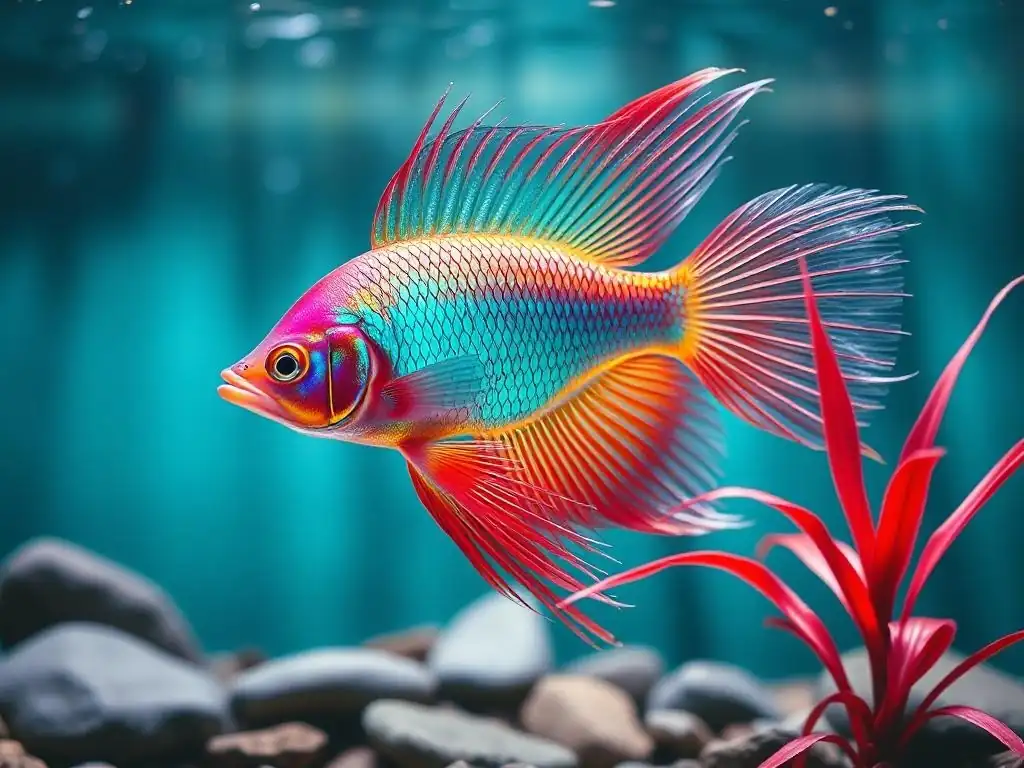
A well-designed aquascape provides a compelling backdrop that enhances the beauty of your Featherfins without overwhelming them. For Cyprichromis species, which naturally inhabit the open water column of Lake Tanganyika, a minimalist setup often works best. Consider using smooth, rounded rocks like river stones or flat slate pieces arranged to create subtle ledges and hiding spots along the back or sides, mimicking their natural environment.
Avoid overly cluttered or busy decorations that might distract from the fish. The goal is to create a sense of depth and natural flow, allowing the Featherfins to be the undisputed stars of the photograph. Incorporating a few tall, slender plants like Vallisneria or Anubias can add vertical interest and a touch of green, providing a pleasing contrast to the fish's colors while maintaining the open water feel essential for showcasing schooling behavior.
Background Considerations for Featherfin Photography
The background of your Featherfin aquarium plays a crucial role in how your subjects stand out. A plain, solid-colored background, such as black or dark blue, often works best as it provides maximum contrast, making the vibrant colors of Cyprichromis species pop. Black backgrounds absorb light, reducing reflections and creating a dramatic, deep-water effect that is highly effective for Featherfin aquarium photography.
Alternatively, a naturalistic background mimicking rock walls or open water can provide a more immersive feel. If using a printed background, ensure it's positioned smoothly and evenly behind the tank to avoid wrinkles or shadows. Experiment with different background colors and textures to see what best complements your Featherfins' unique coloration and enhances the overall visual impact of your Featherfin aquarium photography.
Water Clarity: Achieving Crystal-Clear Water for Stunning Photos
Crystal-clear water is paramount for stunning Featherfin photographs, as even slight haziness can significantly reduce image sharpness, contrast, and color vibrancy. Regular, diligent maintenance is the cornerstone of achieving optimal water clarity. This includes performing consistent weekly or bi-weekly water changes, typically 20-30% of the tank volume, to remove dissolved organic compounds and nitrates that can contribute to cloudiness.
Beyond water changes, ensure your filtration system is robust and well-maintained. Mechanical filtration, such as filter floss or sponges, should be cleaned or replaced regularly to physically remove particulate matter. Chemical filtration, like activated carbon or Purigen, can absorb dissolved impurities and tannins, further polishing the water. A highly efficient filter system, combined with proper water parameters and minimal overfeeding, will ensure your Featherfins are always framed by pristine, optically clear water for the best Featherfin aquarium photography.
Featherfin Photography Techniques: Tips and Tricks
Focusing Techniques for Sharp Featherfin Images
Manual Focus vs. Autofocus for Featherfin Photography
The choice between manual focus (MF) and autofocus (AF) significantly impacts the sharpness of your Featherfin images, especially given their swift movements. Autofocus, particularly continuous AF modes (like AI Servo on Canon or AF-C on Nikon/Sony), is often preferred as it attempts to track and maintain focus on moving subjects. Modern camera AF systems, especially those with eye-tracking or advanced subject recognition, can be remarkably effective at locking onto a fast-moving Cyprichromis.
However, in challenging conditions such as low light, through reflections, or when multiple fish are present, autofocus can "hunt" or lock onto the glass or background instead of the fish. In these scenarios, manual focus can provide greater precision. Pre-focusing on a spot where you anticipate a Featherfin will swim, or using focus peaking (a feature on many mirrorless cameras that highlights in-focus areas), can help achieve critical sharpness. Experimenting with both methods will help you determine the best approach for your Featherfin aquarium photography tips.
Tracking Moving Featherfins: Achieving Focus Consistency
Featherfins are notoriously quick and agile, making consistent focus a primary challenge. To effectively track moving Cyprichromis, use your camera's continuous autofocus mode (AF-C or AI Servo). This mode constantly adjusts focus as the subject moves, rather than locking it in place after the initial acquisition. Select a single-point or small-area AF mode to precisely target the fish, rather than a wide-area mode that might pick up other elements.
Anticipation is key: observe your Featherfins' swimming patterns and try to predict their movements. Frame your shot slightly ahead of the fish, allowing space for it to swim into, and continuously hold down the shutter button for a burst of shots. This technique, known as "spray and pray," increases your chances of capturing a perfectly focused image within a sequence, a valuable approach for Featherfin aquarium photography.
Composition Techniques for Captivating Featherfin Photos
The Rule of Thirds in Aquarium Photography
The Rule of Thirds is a fundamental compositional guideline that can dramatically improve your Featherfin photos. Imagine dividing your image into nine equal sections by two equally spaced horizontal lines and two equally spaced vertical lines. Instead of placing your Featherfin directly in the center, position it along these lines or at their intersections. This creates a more balanced, dynamic, and visually engaging composition.
For a single Featherfin portrait, placing the fish's eye on one of the intersecting points often draws the viewer's gaze naturally into the image. When photographing a school of Cyprichromis, consider positioning the leading fish or a small cluster along a grid line, allowing negative space to convey movement or the vastness of their aquatic environment. Applying the Rule of Thirds makes your Featherfin aquarium photography more professional and appealing.
Creating Depth and Perspective in Featherfin Photos
Creating depth and perspective in your Featherfin photos helps to make the image feel less flat and more three-dimensional, drawing the viewer into the aquatic scene. This can be achieved by incorporating elements at different distances from the camera. For example, placing a few foreground rocks or plants that are slightly out of focus can frame your in-focus Featherfins in the mid-ground.
Utilizing leading lines, such as the natural curve of a piece of driftwood or a line of substrate, can guide the viewer's eye towards your subjects. Varying the focal plane by using a slightly wider aperture (e.g., f/2.8 to f/4) can create a pleasing background blur (bokeh), separating the sharp Featherfins from their surroundings and enhancing the sense of depth. These techniques add an artistic touch to your Featherfin aquarium photography.
Adjusting Camera Settings for Featherfin Photography
Aperture: Controlling Depth of Field for Featherfin Portraits
Aperture, represented by an f-number (e.g., f/2.8, f/8, f/16), controls two key aspects of your Featherfin photos: the amount of light entering the lens and the depth of field (the area of the image that appears sharp). A wider aperture (smaller f-number like f/2.8 or f/4) creates a shallow depth of field, blurring the background and foreground while keeping your Featherfin sharply in focus. This is ideal for isolating a single fish and creating artistic portraits.
Conversely, a narrower aperture (larger f-number like f/8 or f/11) results in a greater depth of field, keeping more of the background and foreground in focus. This is often preferred when photographing a school of Cyprichromis or the entire aquascape to ensure all elements appear sharp. Experiment with different apertures to achieve the desired effect for your Featherfin aquarium photography.
Shutter Speed: Freezing Motion or Creating Blur
Shutter speed dictates how long the camera's sensor is exposed to light and is crucial for capturing fast-moving Featherfins. To freeze the rapid motion of a darting Cyprichromis and ensure a sharp image, a fast shutter speed is essential, typically 1/250th of a second or faster. For particularly active fish, you might need speeds of 1/500th or even 1/1000th of a second to eliminate motion blur.
Alternatively, a slower shutter speed (e.g., 1/30th or 1/60th of a second) can be used to intentionally create motion blur, conveying a sense of movement or fluidity in the water, though this is less common for crisp Featherfin portraits. When shooting with fast shutter speeds, you'll need ample light or a higher ISO to compensate for the reduced light intake. Mastering shutter speed is a core Featherfin aquarium photography tip.
ISO: Balancing Brightness and Noise in Your Featherfin Photos
ISO sensitivity determines how sensitive your camera's sensor is to light. A higher ISO setting (e.g., ISO 800, 1600, or 3200) allows you to capture brighter images in low-light conditions or use faster shutter speeds, which is often necessary for Featherfin aquarium photography. However, increasing ISO also introduces digital noise, which appears as graininess and can degrade image quality, especially in darker areas.
The goal is to use the lowest ISO setting possible while still achieving a properly exposed image with a fast enough shutter speed to freeze motion. Start with your aperture and shutter speed settings, and then adjust ISO as needed to reach the desired brightness. Modern cameras handle higher ISOs much better than older models, but generally, keeping your ISO below 1600 will yield cleaner Featherfin photos.
Capturing the natural behaviors of your Featherfins offers some of the most rewarding photographic opportunities. Observe their routines: when do males perform their elaborate fin-flaring courtship displays for females? When do they engage in sparring or hierarchical interactions? Patience is key. Set up your camera and wait for these moments, often occurring during feeding times or when new fish are introduced.
Spawning events, though rarer, are highly sought after. If you notice a female Cyprichromis holding eggs (buccal incubation), be prepared to photograph her unique mouth-brooding behavior. Documenting these intimate social interactions and reproductive processes provides invaluable insights and creates truly unique Featherfin aquarium photography, showcasing the life and personality within your tank.
Post-Processing Featherfin Aquarium Photos
Basic Editing Techniques for Featherfin Photography
Adjusting Brightness and Contrast
After capturing your Featherfin photos, basic adjustments to brightness and contrast are often the first steps in post-processing. Even perfectly exposed images can benefit from subtle tweaks. Increasing brightness can lift shadows and reveal details, while adjusting contrast enhances the difference between light and dark areas, making the image pop. Be careful not to overdo it, as excessive brightness can blow out highlights, and too much contrast can crush shadows, losing detail.
A slight increase in contrast can make the iridescent scales of Cyprichromis shimmer more effectively, while carefully adjusting brightness can ensure the fish is well-lit without appearing washed out. These foundational adjustments are crucial for bringing out the best in your raw Featherfin aquarium photography.
Color Correction and White Balance
Color correction and white balance are essential for ensuring your Featherfin photos accurately represent their true colors. Aquarium lighting, reflections, and the water itself can sometimes cast an undesirable color tint (e.g., too yellow, blue, or green). Adjusting the white balance corrects these color casts, making whites appear neutral and other colors more natural and vibrant.
Beyond white balance, individual color channels can be fine-tuned. For instance, slightly boosting the blues or yellows can enhance the specific coloration of your Cyprichromis species. Avoid oversaturation, which can make colors look artificial. The goal is to bring out the natural beauty of your Featherfins without making them look unrealistic.
Sharpening and Noise Reduction
Sharpening enhances the definition of edges in your Featherfin photos, making them appear crisper and more detailed. This is particularly useful for bringing out the intricate patterns on fins or the texture of scales. Apply sharpening judiciously, as too much can introduce an unnatural, grainy look or exaggerate existing noise.
Noise reduction techniques help to smooth out the digital graininess that can appear, especially in photos taken at higher ISOs or in low light. While noise reduction can improve the aesthetic, aggressive application can sometimes lead to a loss of fine detail, making the image appear "soft" or "plastic." A balanced approach to both sharpening and noise reduction is key to producing clean, detailed Featherfin aquarium photography.
Software Options for Editing Featherfin Photos
A variety of software options are available for editing Featherfin photos, catering to different skill levels and budgets. For beginners, free tools like GIMP or online editors like Pixlr offer basic adjustments for brightness, contrast, and color. Many operating systems also include built-in photo editors that can handle simple corrections.
For more advanced editing and professional results, Adobe Lightroom and Photoshop are industry standards. Lightroom is excellent for batch processing, organizing, and making non-destructive global adjustments, while Photoshop offers unparalleled control for detailed retouching, masking, and complex manipulations. Both provide powerful tools for refining Featherfin aquarium photography, from subtle enhancements to dramatic transformations.
Advanced Featherfin Photography Techniques
Using External Flashes for Aquarium Photography
While challenging, using external flashes can significantly elevate your Featherfin aquarium photography. An off-camera flash, triggered wirelessly, allows for precise control over light direction and intensity, overcoming the limitations of ambient aquarium lighting. Positioning a flash to the side or slightly above the tank, angled correctly, can minimize reflections and create dramatic highlights and shadows that bring out the fish's form.
However, care must be taken to avoid startling the fish with sudden bright flashes. A diffuser on the flash can soften the light and prevent harsh hot spots. Furthermore, syncing the flash with your camera's shutter speed (often at or below the camera's sync speed, typically 1/200th or 1/250th of a second) is crucial for proper exposure. Experimentation is key to mastering flash photography for Featherfins.
Creating Blackwater Effects for Dramatic Featherfin Portraits
While Featherfins are naturally found in clear, alkaline waters of Lake Tanganyika, intentionally creating a "blackwater" effect in your photos can produce stunningly dramatic portraits. This technique involves using a very dark or black background and underexposing the background slightly while ensuring the Featherfin is perfectly lit. The result is a striking image where the fish appears to float in an endless, inky void, making its colors pop intensely.
This effect is often achieved by carefully balancing the light on the fish (perhaps with a focused light source or flash) with a very dark backdrop that absorbs light. Post-processing can further enhance this by deepening blacks and ensuring no distractions in the background. This artistic approach showcases the Featherfin as a solitary, glowing jewel against a deep, mysterious canvas, offering a unique take on Featherfin aquarium photography.
Photographing Featherfin Fry: Capturing the Next Generation
Capturing Featherfin fry presents a unique and adorable challenge. These tiny fish, often just a few millimeters long when first released by the mother, are incredibly delicate and fast-moving. A macro lens is absolutely essential for these shots to achieve sufficient magnification and detail. Patience is paramount, as the fry will dart in and out of view.
Focusing on such small, active subjects requires a fast shutter speed (e.g., 1/500th second or higher) and often a higher ISO to compensate for the necessary light. A shallow depth of field (wide aperture) can isolate a single fry, blurring out the rest, while a slightly narrower aperture might be needed to get a small cluster in focus. Documenting the development of Featherfin fry is a rewarding aspect of Featherfin aquarium photography, showcasing the full life cycle of these remarkable cichlids.
Troubleshooting Common Featherfin Photography Issues
Dealing with Reflections and Glare
Reflections and glare are among the most common and frustrating issues in Featherfin aquarium photography. Beyond positioning lights at an angle and using dark backdrops behind the camera, a polarizing filter (CPL filter) attached to your lens can be a game-changer. A CPL filter dramatically reduces reflections from glass and water surfaces by filtering out polarized light, allowing you to see through the glare.
Another effective technique is to shoot in a dark room with only the aquarium lights on, minimizing external light sources that can cause reflections. Placing your camera lens as close as possible to the glass, potentially even using a rubber lens hood to create a seal, can also help block ambient light from reflecting into the lens, ensuring a clearer view of your Featherfins.
Overcoming Poor Water Clarity
Poor water clarity can ruin even the best Featherfin photography attempts, making images appear hazy, dull, and lacking contrast. The primary solution is proactive aquarium maintenance: perform regular, sizable water changes (e.g., 25-30% weekly) to remove dissolved organics. Ensure your filtration system is robust and adequately sized for your tank, with mechanical media like filter floss regularly cleaned or replaced to trap particulates.
Consider adding chemical filtration media such as activated carbon or Purigen, which excel at absorbing dissolved impurities that contribute to cloudiness and discoloration. If algae blooms are an issue, address them promptly. Only photograph when your water is pristine; it's nearly impossible to correct significant haziness in post-processing without sacrificing image quality.
Capturing Fast-Moving Featherfins
Capturing sharp images of fast-moving Featherfins is a key challenge. The most critical setting is a fast shutter speed, generally 1/250th of a second or higher, and often 1/500th or 1/1000th for darting fish. Use your camera's continuous autofocus mode (AF-C or AI Servo) to track the fish as it moves, and utilize burst mode (continuous shooting) to take multiple photos in quick succession, increasing your chances of getting a sharp shot.
Anticipation is also vital; observe your Featherfins' typical paths and behaviors. Pre-focus on a spot where you expect them to swim, or try to "pan" your camera with the fish's movement. Increasing your ISO slightly to allow for faster shutter speeds can be a necessary compromise, but balance it to avoid excessive noise. Patience and persistence are key to mastering Featherfin aquarium photography of active subjects.
Showcasing Your Featherfin Photography
AquariumMastery.com is the ideal platform to share your stunning Featherfin photography and connect with a community of fellow aquarists. When preparing your photos for upload, ensure they are appropriately sized and optimized for web viewing to maintain quality without excessively large file sizes. Consider adding a brief description or story behind each photo, such as the specific Cyprichromis species, the behavior captured, or the challenges overcome.
Participating in the site's forums or community sections by sharing your Featherfin aquarium photography tips can also foster engagement and receive valuable feedback. Your contributions not only showcase your talent but also inspire and educate other enthusiasts, building a vibrant and supportive community around the shared passion for Featherfin cichlids.
Participating in Aquarium Photography Contests
Participating in aquarium photography contests, whether online or at local fish club events, offers a fantastic opportunity to gain recognition for your Featherfin photography skills. Many contests have specific categories for fish portraits, aquascapes, or behavioral shots, providing a perfect avenue for your Featherfin images. Carefully review the contest rules regarding image size, format, and any specific themes.
Winning or even placing in a contest provides valuable validation for your work and can open doors to further opportunities. Even if you don't win, the process of selecting and submitting your best Featherfin aquarium photography can be a valuable learning experience, helping you refine your eye for compelling images and receive constructive criticism.
Building a Portfolio of Your Featherfin Photography
Building a dedicated portfolio of your Featherfin photography is an excellent way to showcase your progress and best work. This could be a simple online gallery, a dedicated social media account (like Instagram), or even a personal website. Curate your portfolio carefully, including only your strongest, most visually appealing Featherfin images that demonstrate your technical skill and artistic vision.
Organize your portfolio logically, perhaps by species, behavior captured, or photographic technique. A well-presented portfolio not only serves as a personal archive but also allows you to share your passion with a wider audience, attract potential collaborations, or even inspire others to delve into the rewarding world of Featherfin aquarium photography.
Conclusion: Mastering Featherfin Aquarium Photography
The Rewards of Capturing the Beauty of Your Featherfins
Mastering Featherfin aquarium photography is a journey that combines technical skill, artistic vision, and a deep appreciation for these magnificent Cyprichromis cichlids. While challenging, the rewards are immense. Each perfectly captured image is a testament to the ephemeral beauty of your Featherfins, preserving their vibrant colors, intricate patterns, and unique behaviors in a timeless format.
Beyond the personal satisfaction, your Featherfin aquarium photography contributes to a broader understanding and appreciation of these captivating fish. It allows you to share your passion, educate others, and inspire fellow aquarists to delve deeper into the world of Tanganyikan cichlids. The process of capturing their essence transforms you not just into a photographer, but into a dedicated observer and storyteller of the underwater world you've meticulously created.
Frequently Asked Questions
How can I best capture the delicate details of my Featherfin Catfish in a photograph?
Focus on using a macro lens or a close-up filter to capture the intricate details of their fins. Ensure you have adequate, diffused lighting to avoid harsh shadows that can obscure their beauty.
What camera settings are ideal for photographing Featherfin Catfish in an aquarium?
Use a fast shutter speed (at least 1/125th of a second) to freeze their movements and prevent blur. A low ISO will minimize noise, and a moderate aperture (f/5.6-f/8) can provide a good depth of field.
How do I deal with the reflections and glare from the aquarium glass when photographing my Featherfins?
Minimize reflections by shooting in a darkened room, using a polarizing filter on your lens, and positioning your camera directly in front of the glass. Consider external lighting to reduce internal flash.
What are some techniques for getting my Featherfin Catfish to pose for a photo?
Featherfins are often nocturnal and shy, so patience is key. Try photographing them during feeding time or when they are exploring their favorite hiding spots. Observe their habits to predict their movements.
How can I improve the overall composition of my Featherfin aquarium photographs?
Consider the rule of thirds when framing your shots. Use aquascaping elements like plants and rocks to create visual interest and guide the viewer's eye. Clean the glass before shooting.
Final Reflection: Embracing the Fleeting Moment
The journey of capturing the ephemeral beauty of Featherfin fish, as we've explored, is more than just mastering camera settings; it's about embracing the fleeting moment. In a world obsessed with permanence, the challenge of photographing these delicate creatures reminds us to appreciate the transient nature of beauty and the importance of preserving it, even if only in pixels. The techniques discussed are not merely technical instructions, but a pathway to truly seeing and celebrating the unique grace of these aquatic wonders.
This pursuit of capturing the perfect Featherfin photograph has profoundly influenced my own perspective, teaching me patience and a deeper appreciation for the subtle nuances of the underwater world. It's a reminder that beauty often lies in the unexpected, in the fleeting glimpse of a fin or the gentle sway of a barb. The best and most beautiful things in the world cannot be seen or even touched - they must be felt with the heart.
- Helen Keller. This sentiment resonates deeply when attempting to capture the essence of these elusive creatures, demanding a connection beyond the lens.
Now, armed with these Featherfin aquarium photography tips, I invite you to embark on your own visual exploration. Let the challenge of capturing their ephemeral beauty inspire you to see the world with fresh eyes, to find the extraordinary in the ordinary, and to share your unique perspective with others. May your lens become a tool for both documentation and celebration, preserving the magic of these Featherfins for generations to come.
Unveil the Masterpiece: Immortalize Your Featherfins!
Thank you for diving into the captivating world of featherfin photography. We hope you've gleaned invaluable insights to elevate your aquatic artistry! Now, let's transform knowledge into action.
- Pick up your camera and dedicate the next hour to photographing your featherfins. Experiment with the techniques discussed, and don't be afraid to get creative.
- Share your most captivating featherfin photo on social media using #AquariumMasteryFeatherfins and tag us @AquariumMastery to connect with fellow enthusiasts.
- Try a different camera setting that you usually wouldn't. You may just discover the perfect shot!
What unique perspective will you bring to the art of featherfin photography?