
Betta Bliss: Selecting the Perfect AllInOne System for a Thriving Betta Fish

Welcome to Aquarium Mastery, your ultimate guide to thriving aquatic ecosystems!
Curious about creating the perfect haven for your Betta? Dive in! We'll unravel the secrets to selecting the ideal all-in-one system that will have your Betta living its best life. Ready to unlock a world of Betta bliss? Let's get started!
- Introduction: Creating a Happy Home with the Ideal Betta All-In-One System
- Understanding Betta Fish Needs: Key Factors for a Thriving Betta
- Choosing the Perfect Betta All-In-One Aquarium System: A Buying Guide
- Setting Up Your Betta All-In-One System: A Step-by-Step Guide
- Maintaining Your Betta All-In-One System: Keeping Your Betta Happy and Healthy
-
Frequently Asked Questions
- How do I choose the right size all-in-one system for my Betta?
- What features should I look for in a Betta all-in-one system?
- How does an all-in-one system benefit my Betta's health?
- Are all-in-one Betta systems easy to set up and maintain?
- Where can I find reliable information about maintaining my Betta all-in-one system?
- Final Reflection: Cultivating Aquatic Harmony
- Dive Deeper: Create the Ultimate Betta Paradise!
Introduction: Creating a Happy Home with the Ideal Betta All-In-One System
For many aspiring aquarists, the vibrant Betta fish, often called the Siamese fighting fish, is the gateway to the aquatic hobby. While their beauty is undeniable, providing them with a truly thriving environment requires more than just a small bowl. The key lies in selecting the ideal habitat, and for many, a well-chosen all-in-one aquarium system offers a convenient and effective solution. These integrated setups aim to simplify the initial setup process, combining essential equipment like filtration and lighting into a cohesive unit.
The quest for the perfect Betta all-in-one system is about striking a balance between convenience, aesthetics, and, most importantly, the specific biological needs of this unique fish. A thoughtfully designed all-in-one kit can significantly reduce the complexity of gathering individual components, making it easier for new and experienced hobbyists alike to create a stable and enriching home for their Betta, ensuring their health, color, and longevity.
Understanding Betta Fish Needs: Key Factors for a Thriving Betta
Optimal Tank Size for Betta Comfort: Why Bigger is Better (Usually)
One of the most common misconceptions about Betta fish is that they can thrive in tiny bowls or vases. This is far from the truth. While Bettas can survive in cramped conditions due to their labyrinth organ, which allows them to breathe atmospheric air, they cannot truly thrive. A minimum tank size of 5 gallons (approximately 19 liters) is widely recommended by Betta enthusiasts and experts. This volume provides adequate swimming space, helps maintain stable water parameters by diluting waste products, and offers enough room for essential equipment and enriching decor.
For instance, a 5-gallon tank holds roughly twice the water volume of a 2.5-gallon tank, meaning that any ammonia or nitrite produced by the fish will be diluted significantly more, leading to less frequent or less drastic water quality fluctuations. In a 5-gallon tank, a single feeding of Betta pellets might contribute a small, manageable amount of waste, whereas the same amount in a 1-gallon bowl could lead to a rapid and dangerous spike in ammonia, potentially reaching toxic levels of 0.5 ppm or higher within days if not meticulously managed.
Larger tanks, such as 10 or 15 gallons, are even better, offering enhanced stability and more opportunities for intricate aquascaping, contributing to the Betta's mental and physical well-being.
Water Temperature: The Goldilocks Zone for Betta Health
Betta fish are tropical creatures and require consistent, warm water temperatures to thrive. Their ideal temperature range is typically between 78°F and 82°F (25.5°C to 27.8°C). Deviations from this range can severely impact their health. Temperatures below 75°F can slow their metabolism, suppress their immune system, making them susceptible to common ailments like Ich (white spot disease) or fungal infections, and lead to lethargy and faded colors. Conversely, temperatures consistently above 82°F can increase their metabolism too much, leading to stress and a shorter lifespan.
Maintaining this "Goldilocks Zone" necessitates a reliable aquarium heater with a thermostat and a separate thermometer for accurate monitoring. A 25-watt to 50-watt heater is generally sufficient for tanks in the 5-gallon to 10-gallon range. For example, a Betta kept consistently at 76°F might appear sluggish and dull, refusing food or exhibiting clamped fins, whereas the same fish, once introduced to water maintained at 79°F, often shows a rapid improvement in activity, appetite, and coloration within a day or two. Consistent temperature management is a cornerstone of a truly perfect Betta all-in-one system.
Gentle Filtration: Avoiding Stress for Sensitive Bettas
While Bettas appreciate clean water, they are not suited for strong water currents due to their long, flowing fins. A powerful filter outflow can buffet them around the tank, causing significant stress, exhaustion, and even fin damage over time. Therefore, gentle filtration is paramount when selecting a Betta all-in-one system. Sponge filters, internal filters with adjustable flow rates, or hang-on-back (HOB) filters that can be baffled (e.g., by adding a sponge over the outflow or directing the flow against the tank wall) are excellent choices.
The goal is to provide adequate mechanical and biological filtration without creating turbulent water movement. For a 5-gallon Betta tank, a filter with an output of more than 60-80 gallons per hour (GPH) might be too strong without modification. Many all-in-one systems come with integrated filters; it's crucial to ensure their flow is adjustable or inherently gentle. Observations from long-term Betta keepers consistently show that fish in tanks with strong currents often exhibit signs of stress, such as hiding constantly, struggling to swim, or developing tattered fins, while those in calm, well-filtered environments display natural behaviors and vibrant health.
Choosing the Perfect Betta All-In-One Aquarium System: A Buying Guide
Key Features to Look For in a Betta All-In-One System
- Integrated Filtration: Look for systems with multi-stage filtration (mechanical, chemical, biological) that are designed to be quiet and, crucially, have adjustable or gentle flow rates suitable for Betta fish.
- Adjustable Flow: This is critical for Bettas. A system that allows you to reduce the water flow prevents stress and fin damage.
- Built-in Lighting: Adequate lighting is essential for viewing your Betta, promoting plant growth (if desired), and establishing a day/night cycle. Look for LED lights, preferably with a timer or adjustable spectrum.
- Heater Compatibility: Ensure the system has space for a submersible heater of appropriate wattage for the tank size, or ideally, includes one.
- Durable Construction: Opt for tanks made from high-quality glass or acrylic that are leak-proof and scratch-resistant.
Top Recommended Betta All-In-One Systems: Reviews & Comparisons
- Fluval Flex 15 Gallon: This system is highly regarded for its larger volume, providing ample space for a Betta. It features a unique curved front, powerful multi-stage filtration hidden at the back, and adjustable flow. The included LED lighting system offers various color options and effects, making it excellent for plant growth and showcasing your Betta's colors. Its generous size contributes significantly to water stability.
- Aqueon NeoGlow 5.5 Gallon: A popular choice for those seeking a compact yet suitable Betta home. This system often comes with a basic filter and an LED hood. Its 5.5-gallon capacity meets the minimum size requirement, and while the filter flow might need minor baffling for very sensitive Bettas, it's a solid entry-level option for a perfect Betta all-in-one system. The LED lighting, while not as advanced as higher-end models, provides sufficient illumination.
- Marineland Portrait 5 Gallon: This vertically oriented 5-gallon tank is known for its sleek design and hidden filtration system. It includes bright white and blue LED lights that can be switched between day and night modes. The filtration is integrated into the back chamber, offering a clean look. While vertical tanks provide less horizontal swimming space than standard rectangular tanks of the same volume, the Marineland Portrait offers sufficient room and a quiet filter, making it a visually appealing option.
Comparing All-In-One Betta Systems: Features, Price, and Suitability
When seeking the perfect Betta all-in-one system, comparing options across features, price, and suitability is crucial. The Fluval Flex 15 Gallon, for instance, represents a premium choice.
Its larger volume (15 gallons) inherently provides superior water stability and more horizontal swimming room compared to 5-gallon options, reducing the likelihood of water quality issues and allowing for more elaborate aquascaping. While it typically comes at a higher price point, its advanced filtration with adjustable flow and robust lighting make it an excellent long-term investment for a thriving Betta, often requiring fewer water changes than smaller tanks due to increased dilution capacity.
In contrast, the Aqueon NeoGlow 5.5 Gallon and Marineland Portrait 5 Gallon fall into the mid-range price bracket, offering suitable minimum tank sizes for Bettas. The Aqueon NeoGlow is a straightforward, functional choice, often appealing to budget-conscious beginners. Its simplicity means the integrated filter might require a slight modification (like adding a sponge to the outflow) to reduce current for particularly long-finned Bettas.
The Marineland Portrait offers a more aesthetically driven design with its hidden filtration and bright lighting, making it a popular choice for those valuing appearance. However, its vertical orientation means slightly less linear swimming space than a standard horizontal 5-gallon tank, which some Betta owners might consider. Ultimately, the "perfect Betta all-in-one system" depends on balancing budget, available space, and the specific needs of your Betta, with larger volumes almost always translating to greater ease of maintenance and fish well-being.
Setting Up Your Betta All-In-One System: A Step-by-Step Guide
Unboxing and Preparation: What to Expect
Upon receiving your chosen all-in-one system, carefully unbox all components and inspect for any damage during shipping. It's crucial to rinse the tank thoroughly with clean, lukewarm water – never use soap or chemical cleaners, as residues can be toxic to fish. Similarly, rinse all included equipment such as the filter media, light fixture, and any plastic decor. This initial rinse removes manufacturing dust and any potential contaminants.
Before filling, ensure the tank is placed on a sturdy, level surface that can support its significant weight when full. A 5-gallon tank, once filled with water, substrate, and decor, can weigh approximately 50-60 pounds (23-27 kg), while a 15-gallon system can easily exceed 150 pounds (68 kg). Reading the manufacturer's specific instructions for your perfect Betta all-in-one system is also paramount, as assembly details for integrated components can vary between models.
Setting Up the Filtration System: Ensuring Clean and Healthy Water
The integrated filtration system is a cornerstone of any all-in-one unit. Begin by installing the filter media into their designated compartments, typically following a mechanical (sponge/filter floss), chemical (activated carbon, if used), and biological (ceramic rings or bio-balls) order. The mechanical media physically removes particles, chemical media removes impurities and odors, and biological media provides surface area for beneficial bacteria to colonize, which are essential for processing fish waste.
Once the media is in place, ensure the filter pump is correctly seated and the outflow nozzle is positioned as per the instructions. For a Betta, it's critical to assess the water flow. If the current appears too strong (e.g., pushing your hand significantly, or creating a visible "river" effect), consider baffling the outflow.
This can be done by directing the flow against a tank wall or by attaching a small sponge to the output nozzle. Aim for a gentle, even dispersion of water, ensuring your Betta can swim freely without being constantly pushed around, which is vital for a truly perfect Betta all-in-one system.
Installing the Heater and Thermometer: Maintaining Optimal Temperature
For a tropical Betta, a reliable heater is non-negotiable. Select a heater with appropriate wattage for your tank size; a 25-watt to 50-watt heater is generally suitable for 5-10 gallon tanks. Position the heater fully submerged (if submersible) in an area with good water circulation to ensure even heat distribution throughout the tank. Avoid placing it directly under the filter intake or outflow, as this can lead to inaccurate temperature readings or uneven heating.
Once the heater is installed, place an accurate thermometer on the opposite side of the tank or in an area away from the heater to get a true ambient water temperature reading. Do not plug in the heater until the tank is filled with water. After filling the tank and plugging in the heater, allow at least 24 hours for the water temperature to stabilize within the ideal Betta range of 78-82°F (25.5-27.8°C) before introducing your fish. Consistent monitoring will help maintain the perfect Betta all-in-one system environment.
Adding Substrate and Decor: Creating a Natural Environment
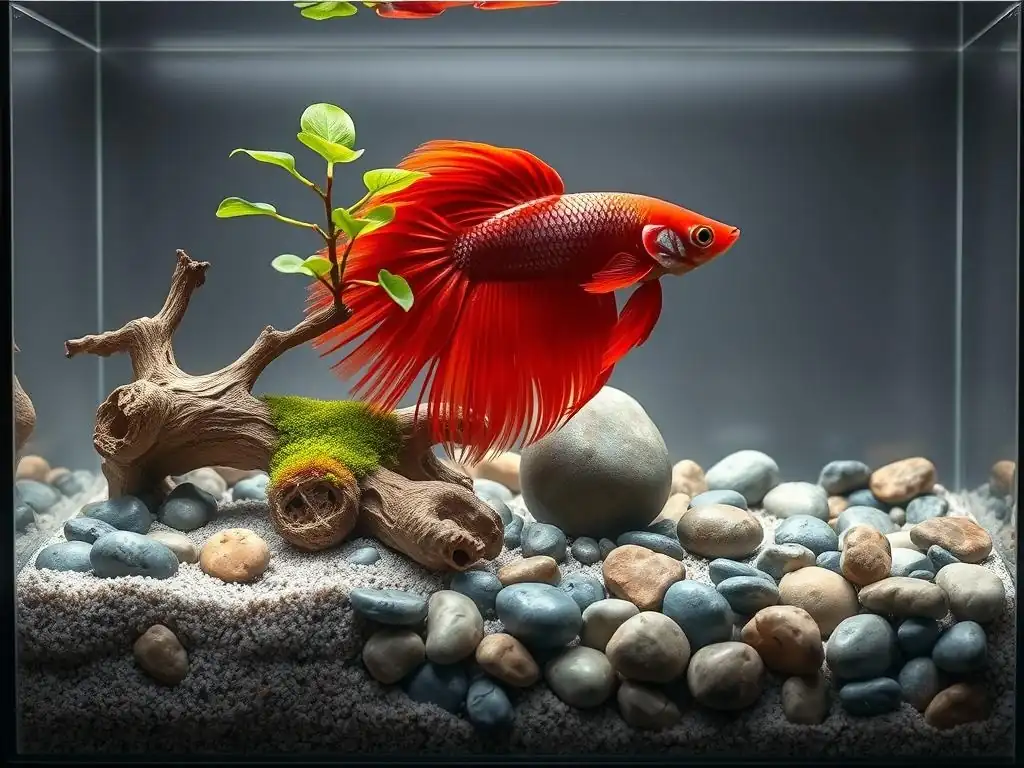
The substrate forms the base of your Betta's habitat. Rinse your chosen substrate thoroughly under running water until the water runs clear to remove any dust or fine particles that could cloud your tank. Fine gravel or sand is suitable, as sharp or coarse substrates can potentially harm a Betta's delicate fins. Aim for a substrate depth of 1 to 2 inches (2.5-5 cm), which is sufficient for beneficial bacteria to colonize and for rooting live plants if you choose to add them.
Next, introduce your decor. Select items that are smooth and free of sharp edges or rough textures that could tear fins. Live plants (like Anubias, Java Fern, or Amazon Swords) are ideal as they oxygenate the water, absorb nitrates, and provide natural hiding spots.
If using artificial plants, opt for silk plants over plastic ones. Include hiding spots such as caves, driftwood, or ceramic logs, and consider a Betta leaf hammock or floating log near the surface, as Bettas enjoy resting on broad leaves or close to the water's surface to breathe. These elements enrich the environment of your perfect Betta all-in-one system, reducing stress and promoting natural behaviors.
Cycling Your Betta Tank: Establishing a Healthy Ecosystem
Cycling your Betta tank is arguably the most critical step before adding your fish. This process establishes a colony of beneficial bacteria in your filter media and substrate that convert toxic ammonia (from fish waste and uneaten food) into less toxic nitrite, and then into even less toxic nitrate. Without this bacterial colony, ammonia and nitrite will quickly build up to lethal levels for your Betta. This biological filtration process, known as the nitrogen cycle, typically takes 2 to 6 weeks to complete.
The most humane and recommended method is fishless cycling. This involves adding a small amount of an ammonia source (like pure ammonia solution or a pinch of fish food) to the tank daily and monitoring water parameters with a liquid test kit (ammonia, nitrite, nitrate, pH). The cycle is complete when both ammonia and nitrite levels consistently read 0 ppm, and nitrate levels are present but manageable (below 20 ppm). This ensures that your perfect Betta all-in-one system has a stable, self-sustaining ecosystem ready to safely house your fish.
Maintaining Your Betta All-In-One System: Keeping Your Betta Happy and Healthy
Regular Water Changes: Maintaining Water Quality
Regular water changes are fundamental to the long-term health of your Betta and the stability of your all-in-one system. Even with a well-established filter, nitrates (the end product of the nitrogen cycle) accumulate over time and need to be removed. A weekly water change of 25-30% of the tank volume is generally recommended for a Betta tank. For example, in a 5-gallon tank, this means removing approximately 1.25 to 1.5 gallons of water.
During the water change, use a gravel vacuum to siphon out water while simultaneously removing uneaten food, fish waste, and detritus from the substrate. Always replace the removed water with fresh, dechlorinated water that is temperature-matched to the tank to avoid shocking your Betta. Sudden temperature drops can lead to stress and susceptibility to diseases like Ich. Consistent, routine water changes are key to maintaining pristine water conditions in your perfect Betta all-in-one system.
Filter Maintenance: Ensuring Optimal Filtration
Proper filter maintenance ensures your filtration system continues to function efficiently without disrupting the beneficial bacterial colonies. Avoid cleaning your filter media under tap water, as the chlorine can kill these essential bacteria. Instead, gently rinse filter sponges and bio-media in a bucket of old tank water siphoned during a water change. This removes accumulated detritus without destroying the bacterial colonies.
Chemical media, such as activated carbon, should be replaced every 2 to 4 weeks as it loses effectiveness. However, avoid replacing all filter media at once, especially biological media, as this can lead to a "mini-cycle" where ammonia and nitrite spike. If you need to replace bio-media, do so gradually or ensure you have an established second source of beneficial bacteria. Regularly check the filter intake for debris or plant matter that might restrict water flow, ensuring your perfect Betta all-in-one system's filtration remains robust.
Monitoring Water Parameters: Keeping Track of Water Chemistry
Consistent monitoring of water parameters is crucial for proactive tank management and Betta health. At a minimum, regularly test for ammonia, nitrite, and nitrate using a reliable liquid test kit (which is generally more accurate than test strips). Ammonia and nitrite should always be 0 ppm in a cycled tank. Nitrate levels should ideally be kept below 20 ppm through regular water changes.
Monitoring pH (potential hydrogen) is also important; Bettas generally thrive in a pH range of 6.5 to 7.5, but consistency is more vital than hitting an exact number. Finally, always keep an eye on the water temperature with a thermometer, ensuring it remains within the ideal 78-82°F range. Detecting any parameter shifts early allows for timely intervention—such as an emergency water change if ammonia or nitrite suddenly appear—preventing stress and illness in your Betta, thereby ensuring the sustained success of your perfect Betta all-in-one system.
Frequently Asked Questions
How do I choose the right size all-in-one system for my Betta?
Bettas need at least 5 gallons to thrive. Look for an all-in-one system that provides ample space and good water quality. Avoid systems smaller than 5 gallons for optimal Betta health.
What features should I look for in a Betta all-in-one system?
Essential features include a built-in filter, heater, and adjustable flow rate. Consider systems with integrated lighting suitable for Betta's needs, and ensure the system is easy to maintain.
How does an all-in-one system benefit my Betta's health?
An all-in-one system simplifies maintaining stable water parameters. The integrated filtration and heating help create a consistent and healthy environment, reducing stress and disease risk for your Betta.
Are all-in-one Betta systems easy to set up and maintain?
Yes, they are generally designed for ease of use. Most all-in-one systems come with clear instructions and require less individual component setup compared to building a custom tank.
Where can I find reliable information about maintaining my Betta all-in-one system?
AquariumMastery.com offers detailed guidance on maintaining freshwater aquariums, including Betta tanks. Explore our articles on water chemistry, maintenance schedules, and troubleshooting common issues.
Final Reflection: Cultivating Aquatic Harmony
The journey to creating a thriving Betta environment, as explored in this article, is more than just selecting the perfect Betta all-in-one system; it's about understanding and respecting the delicate balance of an aquatic ecosystem. In today's fast-paced world, where convenience often overshadows mindful living, taking the time to create a suitable habitat for a Betta fish serves as a powerful reminder of the importance of responsible pet ownership and the interconnectedness of all living things.
This pursuit of Betta bliss has profoundly influenced the way we perceive aquarium keeping, shifting from mere decoration to a commitment to animal welfare. The dedication to providing a stimulating and healthy environment for a Betta reflects a broader societal shift towards conscious consumerism and ethical treatment of animals. As the renowned oceanographer Jacques Cousteau once said, The sea, once it casts its spell, holds one in its net of wonder forever.
This sentiment extends to the microcosm of a Betta tank, where we can witness the beauty and fragility of life firsthand.
Now, consider the lessons learned in creating your Betta's perfect home. How can you apply this same level of care, attention, and dedication to other aspects of your life? Let the pursuit of "Betta Bliss" inspire you to cultivate harmony and well-being, not just for your aquatic companion, but for yourself and the world around you.
Dive Deeper: Create the Ultimate Betta Paradise!
Thank you for exploring the world of Betta bliss with Aquarium Mastery. We hope you’ve gained valuable insights into selecting the perfect all-in-one system to nurture your Betta's well-being. Ready to put that knowledge into action?
Here are a few ways to continue your journey:
- Transform your tank: Start researching and planning your ideal all-in-one Betta system today!: This is the perfect next step.
- Share your current setup and ask for advice in our Betta Buddies community forum - let’s troubleshoot and inspire each other.
- Experiment with aquascaping ideas: try arranging items in the tank to create new visual and resting places for your Betta.
What unique feature are you most excited to include in your Betta's dream home?