
Are Tetras Intelligent? Exploring the Surprising Behaviors of These Small Fish

Welcome to Aquarium Mastery!
Ever wondered if those shimmering tetras in your tank are more than just pretty faces? Prepare to be amazed as we dive deep into the fascinating world of Intelligent Tetra Fish Behavior. Discover the surprising cognitive abilities and social complexities of these captivating creatures. Ready to unlock the secrets behind their seemingly simple lives? Let's explore!
Schooling Behavior: A Sign of Collective Intelligence in Tetras?
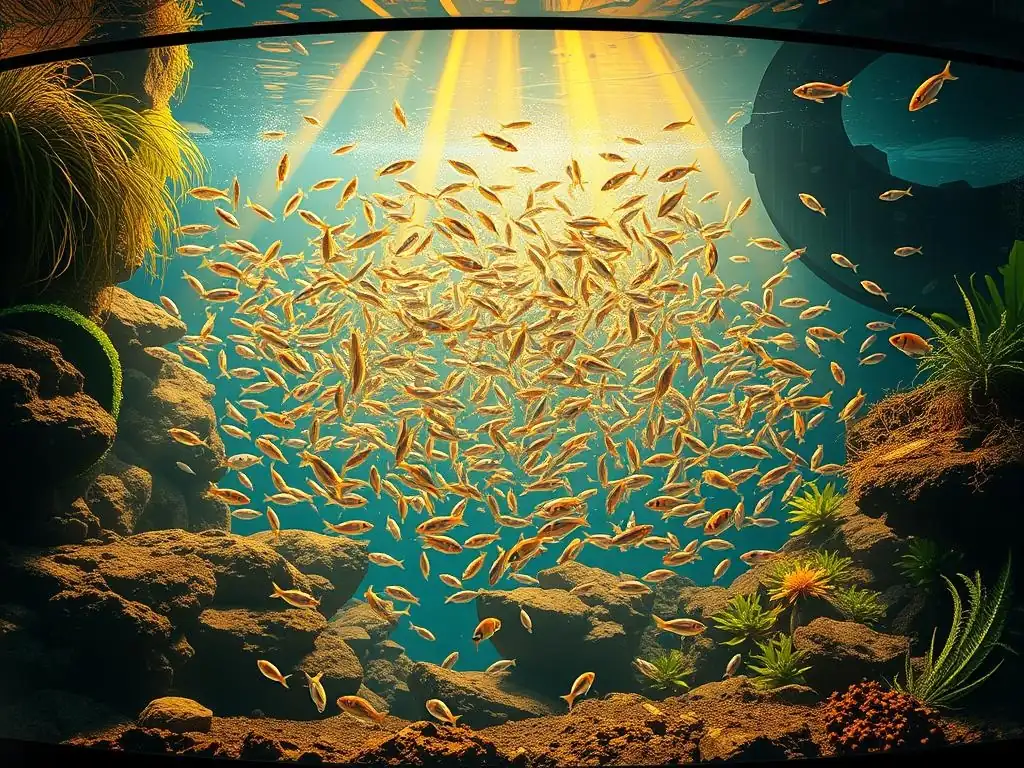
Schooling in tetras is often perceived as a simple, instinctual response to predators, but a closer look reveals a sophisticated collective behavior that hints at underlying cognitive processes. When hundreds, or even thousands, of individual tetras move as a single, cohesive unit, it requires constant communication and rapid information exchange among the group members.
This isn't merely a reflexive action; it involves individual fish adjusting their speed, direction, and proximity to neighbors based on subtle cues, demonstrating a remarkable level of coordination. This highly synchronized movement allows the school to effectively evade threats and forage more efficiently, showcasing a form of intelligent tetra fish behavior that transcends individual awareness.
Observations in controlled environments suggest that the decision-making within a school can be distributed, with information about a perceived threat or a food source quickly propagating through the entire group. For instance, if a predator approaches, the initial reaction of a few individuals can trigger a ripple effect, leading to a sudden, coordinated change in direction by the entire school, often within milliseconds.
This rapid collective response, far more effective than any single fish could achieve alone, indicates a complex system of social learning and adaptation. Such dynamic coordination points towards a level of group intelligence where the sum is greater than its parts, making schooling a prime example of intelligent tetra fish behavior.
Problem Solving: Can Tetras Learn and Adapt?
While tetras may not be renowned for complex problem-solving akin to some larger, more solitary fish, their ability to navigate their environment and adapt to new situations suggests a foundational capacity for learning. In an aquarium setting, tetras quickly learn the layout of their tank, remembering the locations of hiding spots, preferred resting areas, and feeding zones. They can adapt to changes in tank décor, initially showing hesitation but soon integrating new elements into their navigational map. This adaptive capacity is a basic form of problem-solving, as they are constantly processing new information and adjusting their behaviors accordingly.
Anecdotal evidence from aquarists often highlights how tetras can learn to associate specific cues with feeding time. For example, the presence of their owner or a particular sound can prompt them to gather at the water's surface, anticipating food. This associative learning, where they link an external stimulus with a predictable outcome, demonstrates their capacity to learn from experience. While they might not be solving intricate mazes, their consistent ability to adapt to their captive environment and respond to learned cues points to a practical, intelligent tetra fish behavior focused on survival and resource acquisition.
The social dynamics within a tetra school, and their interactions with other species in a community tank, suggest a degree of social cognition. While precise studies on individual recognition in tetras are limited, their consistent grouping patterns and peaceful cohabitation with suitable tank mates indicate an ability to distinguish between familiar and unfamiliar individuals, and potentially even different species. They exhibit comfort and specific behaviors when schooling with their own kind, and generally maintain a respectful distance from larger, potentially predatory species, showcasing an awareness of their social environment.
Beyond recognizing fellow fish, many aquarists report that their tetras appear to recognize their human owners. This recognition often manifests as excitement or gathering at the front of the tank when the owner approaches, especially around feeding times.
While this could be attributed to a conditioned response to a general shape or shadow, the consistency and specificity of the reaction across different individual tetras suggest a more nuanced form of recognition. This capacity to associate a specific human presence with positive outcomes (like food) points to a level of memory and social learning, contributing to the observed intelligent tetra fish behavior in home aquariums.
Memory and Learning: Do Tetras Remember Past Experiences?
The capacity for memory and learning is fundamental to any discussion of intelligence, and tetras, despite their small size, demonstrate these abilities in various ways. They exhibit both short-term and long-term memory, particularly concerning their environment and feeding routines. For example, a tetra can remember the location of a newly introduced food source for several hours or even days, returning to that spot even if the food is not immediately present. This spatial memory is crucial for foraging efficiency in their natural habitats and is replicated in the aquarium.
Furthermore, tetras show evidence of associative learning, where they form connections between different stimuli. If a specific area of the tank is consistently associated with a startling event, such as a sudden tap on the glass, tetras will often learn to avoid that area or react with increased caution when near it.
Conversely, they quickly learn to respond to feeding cues, such as the sound of a food container opening or the sight of their owner. This ability to recall past experiences and adjust future behaviors based on those memories is a clear indicator of a practical, intelligent tetra fish behavior that aids in their survival and well-being.
- Schooling Behavior: A Sign of Collective Intelligence in Tetras?
- Problem Solving: Can Tetras Learn and Adapt?
- Recognizing Tank Mates and Owners: Social Cognition in Tetras
- Memory and Learning: Do Tetras Remember Past Experiences?
- Are tetras truly intelligent, or are their behaviors simply instinctual?
- What specific behaviors suggest intelligent tetra fish behavior?
- How does the size of a tetra school impact their observed intelligence?
- Can tetras be trained to perform tricks or respond to commands?
- What factors in a tetra's environment can affect their behavior and apparent intelligence?
Frequently Asked Questions
Are tetras truly intelligent, or are their behaviors simply instinctual?
While instinct plays a role, tetras exhibit behaviors suggesting more than just programmed responses. They can learn to recognize their feeding times and even recognize their owners.
What specific behaviors suggest intelligent tetra fish behavior?
Tetras display complex social interactions within their schools, like coordinated movements and hierarchical structures. They also show adaptability in response to changes in their environment and even problem-solving skills in certain situations.
How does the size of a tetra school impact their observed intelligence?
Larger schools often exhibit more complex behaviors, suggesting that collective intelligence emerges from group dynamics. More individuals allow for better communication and information sharing.
Can tetras be trained to perform tricks or respond to commands?
While not as easily trained as some other fish species, tetras can be trained to associate specific actions with food. This demonstrates a basic form of associative learning and cognitive ability.
What factors in a tetra's environment can affect their behavior and apparent intelligence?
Water quality, tank size, and the presence of hiding places all significantly impact a tetra's behavior. Stressful environments can inhibit natural behaviors, making them appear less intelligent.
Final Reflection: Unveiling the Minds of the Miniature
The exploration of tetra intelligence, as we've seen, isn't just about assigning a label; it's about recognizing the complex behaviors and adaptive strategies these tiny creatures employ. In a world increasingly focused on understanding the sentience of all living beings, acknowledging the potential for intelligence in even the smallest fish is a crucial step towards a more holistic and compassionate view of the natural world.
The surprising behaviors we've uncovered highlight the interconnectedness of life and challenge our anthropocentric biases. Personally, witnessing the adaptability and problem-solving skills of tetras has profoundly shifted my perspective on what constitutes intelligence. The question is not, 'Can they reason?' nor, 'Can they talk?' but, 'Can they suffer?'
- Jeremy Bentham's words resonate deeply here, reminding us that intelligence, in its many forms, deserves our respect and consideration.
Now, armed with a deeper understanding of intelligent tetra fish behavior, I invite you to reflect on your own interactions with the natural world. Consider the subtle cues, the hidden complexities, and the potential for intelligence that exists all around you, waiting to be discovered. Let us strive to cultivate a greater appreciation for all life, regardless of size or perceived simplicity, and work towards a future where every creature is valued for its unique contribution to the intricate tapestry of our planet.
Dive Deeper: Transform Your Tetra Knowledge!
Thank you for exploring the fascinating world of tetras with us! We hope you've discovered some surprising insights into their intelligence and behavior. Ready to put your newfound knowledge into action?
Here are a few things you can do next:
- Begin observing your own tetras more closely, looking for the behaviors we discussed. Can you identify individual personalities or problem-solving strategies?
- Share this article with fellow aquarium enthusiasts to spark discussion about tetra intelligence and care. Let's get the conversation flowing!
- Consider adding a new enrichment activity to your tetra tank – introduce a new, safe plant or rearrange the decorations and see how they react.
What's the most surprising tetra behavior you've ever witnessed, and how did you interpret it? Share your stories in the comments below!